
 Why “Data Strength” Is Now Your Biggest Competitive Advantage
If you’ve noticed your website traffic, leads, or visibility behaving differently lately, you’re not imagining it. Google is continuing its shift toward AI-driven search and advertising—and the latest guidance from Google makes one thing very clear:
Your success is no longer just about keywords or rankings. It’s about your data.
What Google Just Announced
In its latest Accelerate guide, Google emphasizes something called “Data Strength.”
This refers to how well your business collects, connects, and uses data across platforms—especially for AI-powered marketing (AI SEO & GEO).
The goal is simple:
Help Google’s AI make better decisions about when and where to show your business.
According to Google, stronger data allows its AI systems to:
- Better understand your customers
- Optimize campaigns automatically
- Improve performance across search, maps, and ads
Why This Matters for Local Businesses
For most small businesses, this is a major shift.
In the past, visibility came from:
- Ranking your website
- Building backlinks
- Optimizing pages
Now, AI is deciding what to show users—especially in:
- Google Maps
- AI Overviews
- Voice and conversational search
And AI relies heavily on signals, not just content.
If your data is weak or disconnected, Google’s AI has less confidence in your business.
The 3 Big Changes You Need to Understand
1. AI Doesn’t Just Read Your Website Anymore
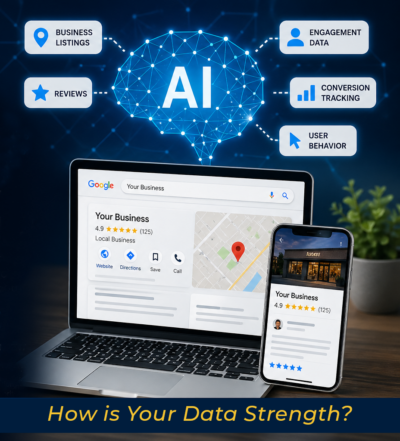
Google now pulls signals from multiple sources:
- Google Business Profile
- Reviews
- Engagement data
- Conversion tracking
- User behavior
This means your entire digital presence matters—not just your site.
2. Conversion Tracking Is Critical
Google emphasizes that accurate conversion data is one of the most important inputs for AI optimization.
If your tracking is broken or incomplete:
- AI can’t learn what’s working
- Campaign performance suffers
- You waste budget
This is one of the biggest hidden issues we see with new clients.
3. Connected Data = Better Results
Google’s AI works best when your systems are connected:
- Website (Google Analytics / GA4)
- Ads
- CRM or lead tracking
- Business listings
The more complete the data loop, the smarter the AI becomes.
What This Means for Your Marketing Strategy
Here’s the reality:
SEO alone is no longer enough.
To stay competitive in 2026, your strategy needs to include:
1. Strong Local Signals
Optimized Google Business Profile
Consistent listings (Apple, Yelp, directories)
Ongoing updates and activity
2. Clean, Reliable Data
Proper GA4 setup
Conversion tracking (calls, forms, clicks)
Accurate attribution
3. AI-Ready Content (GEO)
Content that answers real questions
Clear, structured information
Authority and trust signals
Google has also confirmed that traditional SEO best practices still apply, but it now supports AI-driven results rather than controlling them directly.
The Biggest Mistake We’re Seeing
Most small businesses are still:
- Running ads without proper tracking
- Ignoring their business listings
- Treating SEO as a one-time setup
This creates a data gap—and in an AI-driven world, that gap costs visibility.
What We’re Doing Differently at Axys Digital Marketing
We’ve shifted our approach to match Google’s AI direction:
Our focus:
- Local Search Optimization (Maps & Listings)
- GEO (Generative Engine Optimization) & AI SEO
- Data tracking and signal optimization
Because today, visibility isn’t just about being found…
It’s about being understood by AI.
Final Takeaway
Google’s message is clear:
The businesses with the strongest, cleanest, and most connected data will win.
If your marketing isn’t built around that yet, you’re already behind—but it’s fixable.
Want to Know Where You Stand?
We offer a simple AI Visibility & Data Strength Audit to help you understand:
- What Google’s AI sees about your business
- Where your data gaps are
- How to improve your visibility quickly